(Originally from Facebook – August 19, 2013)
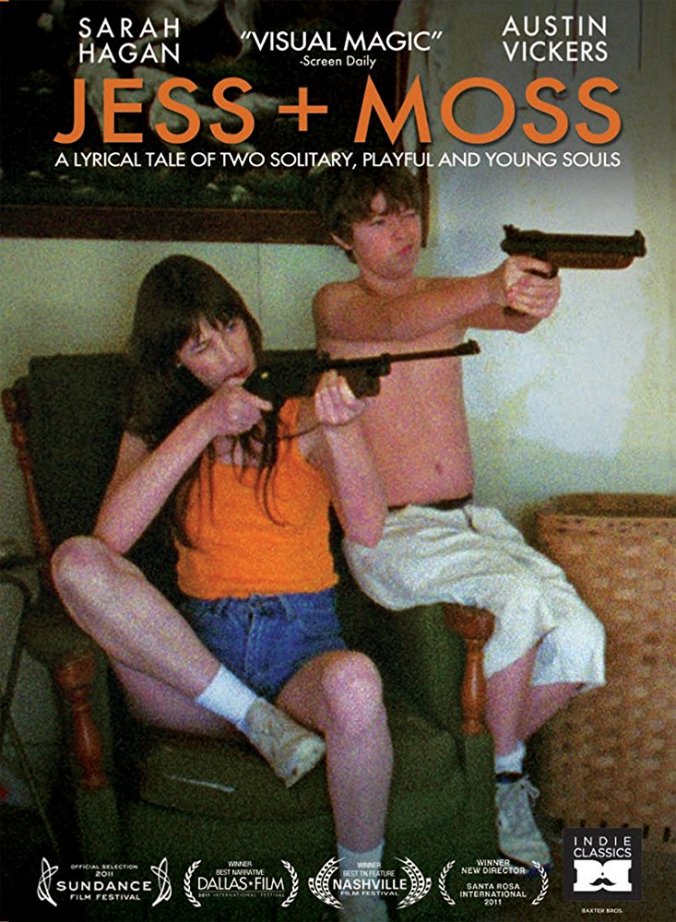
Last night’s film was unlike anything I’ve seen, at least in recent memory. It was a popular entry at Sundance a couple of years ago, and a decidedly unconventional one. It doesn’t really have a plot…or a traditional narrative structure (more on that in a minute)…or more than the two title characters. It’s a series of loosely connected snippets. (I can’t even call them “vignettes,” as some reviewers have.) They all deal with the relationship between 18-year-old Jess and 12-year-old Moss, whose parents were best friends. Some of the snippets are shot traditionally, some are shot to give a slow-motion, dreamlike feel, and some are shot with a cassette-tape voice over from various characters. Almost all of it takes place in rural Kentucky, where Jess and Moss seem to have the run of the place.
The film seems organized around two major themes. The first is memory, as evidenced by Jess’s playing of her mother’s cassette tapes (she left Jess and her father), and Moss’s (who is an orphan) obsession with both listening to the “Mega Memory” series of cassettes, and having Jess tell him the same stories over and over, as though he’s trying desperately to fix them permanently in his mind. The second theme is that of decay–of the landscape, of the abandoned house they play in, of the blissful irresponsibility of childhood. Jess, in particular, seems to be trying to avoid having to enter adulthood. She’s sexually inexperienced, yet (as first-time director Clay Jeter reminds us with shots that focus on her breasts, behind, and long legs) physically, she is a woman. It more than once crosses the viewer’s mind that she is too old to be Moss’s best friend. Together, though, they play at domestication in an abandoned farmhouse, setting the table for dinner with broken plates, etc. They are alone nearly the entire film, an Adam and Eve in a decaying Kentucky Eden.
The performances are very good, although at 27, Sarah Hagan is starting to stretch the limits of credulity in playing a teenager. Consider that she was playing one in “Freaks and Geeks” a decade ago. She also gives the more complex, nuanced performance, however, which is not to say that newcomer Austin Vickers is bad. He does a fine job.
It’s the film itself that is the star here. Beautifully shot on film stock of various age and gradation, it contributes to those two themes–memory and decay. It’s often reminiscent of old home movies, and occasionally a shot rewinds for a couple of seconds, as though we’re trying to hold onto the memory just a bit longer. As I said, there isn’t much of a plot here, but honestly–I didn’t care. I really liked this film, and the more I turn it over in my mind, the more complex I think it is, and the more I like it. It isn’t for everyone. I saw a couple of reviews that made comparisons to Malick and Lynch, and I suppose I could see that. I’m not a huge fan of either director, though, and I still liked this film immensely. Had I seen it back in 2011, it very well could have been on my top ten list. It’s hypnotic and sad and beautiful. I will be very interested in seeing where Jeter goes from here.
IMDB scores it at 5.7, but I would easily put it at an 8.0, although that’s really a matter of personal taste, as it’s such an unconventional film. (running time 1:23)
 Who Cares What You Think?