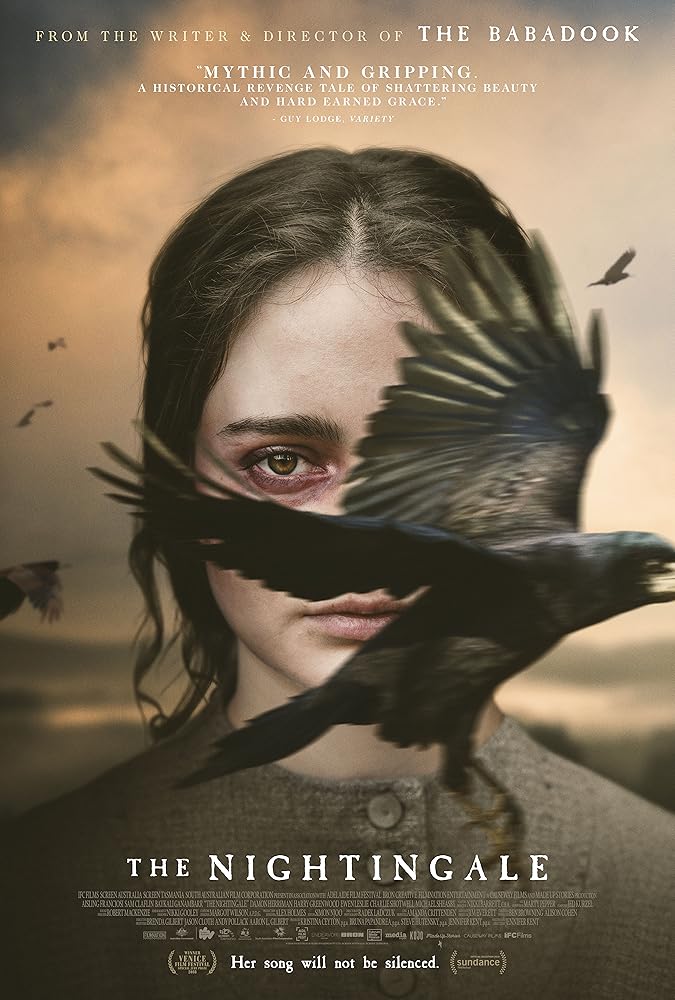
Director: Jennifer Kent
Writer: Jennifer Kent
I have to start this with a word of warning: this is an extremely hard film to watch. It’s not just that it’s bloody. There are also several scenes of rape, and a shit-ton of racism. My understanding is that people have walked out of the film when it’s been shown on the festival circuit. That said, if you can tough it out, you’ll find a very powerful, well-made film.
1825: Claire (Aisling Franciosi) is a young Irish woman and former convict who is indentured to Lieutenant Hawkins (Sam Claflin), the leader of an unruly group of British soldiers stationed in Tasmania. He refuses to release her from her servitude, and forces himself on her, angering her husband Aiden (Michael Sheasby), who confronts Hawkins and his men publicly one night. Once Hawkins’ misdeeds are uncovered, he loses the commission he was promised, and blaming Claire, he kills her family and leaves her for dead.
But Claire’s not dead, and the next morning she sets out after Hawkins and his men, hell-bent on revenge. She enlists the help of Billy (Baykali Ganambarr), an Aboriginal tracker. If you’re not up on your history, this all takes place in the middle of what was known as “The Black War,” a bloody era in which the British, in the process of colonizing the land, committed savage atrocities upon the native people. I bring that up not only to give some context to the synopsis, but to explain just how dangerous it was for a “blackfella” to be traveling alone with a white woman.
Although on its surface, it appears to be a straight-up revenge tale, the crux of the story is really about Claire and Billy learning to deal with their individual traumas and to trust and depend on one another in a dangerous and volatile world. The film’s potential for success falls upon the shoulders of the two leads, and both deliver outstanding performances. I know I’ve used the term “fearless” to describe a performance before, but I don’t think I’ve ever used it more appropriately than to describe Franciosi in this film. She gets put through the emotional and physical wringer here and handles it all capably. Ganambarr gives Billy a quiet strength and a charisma that serves him well both as Claire’s protector and as a victim of the sweeping violence that is destroying his people. And Clafin’s Hawkins is just…irredeemable. He makes it really easy for you to hate him. He is one evil fucker.
Kent’s sophomore feature is quite different than her first film, 2014’s The Babadook. Both are billed as “horror” films, but this one is not a horror film in the cinematic sense; it’s much more literal. There are very few nods to traditional horror film tropes. (A couple of dream sequences with visions of the dead are the exception.) And Kent never tries to temper her film by dipping into that pool of epiphanic emotional growth. You know what I’m talking about: two characters of different races spend a bunch of time together, and—lo and behold—by the end of the film they’ve come to appreciate one another and have become the best of friends! Claire and Billy never really get there. Their companionship, for lack of a better term, comes not from a place of equality and acceptance, but rather from the recognition that they both have suffered loss at the hands of the British “whitefellas.” The enemy of my enemy is my friend.
Don’t let my initial warning deter you too much. It’s something I felt needed to be said, but I also think that it’s just one aspect of the film, and if nothing else, those scenes are effective. It is not a film you will forget anytime soon.
IMDb has it at a 7.3. I would go a little higher than that, putting it in the 7.5-8.0 range, depending on how well you can handle the emotionally difficult material. I always enjoy a film that provokes an emotion, no matter what that emotion happens to be, over one that leaves me feeling indifferent. (running time 2:16)
 Who Cares What You Think?