Director: Quentin Tarantino
Writer: Quentin Tarantino
As usual with Quentin Tarantino films, I never seem to like them as much as others do. His movies always seem so self-indulgent, and this one seemed even more so than usual. As usual, QT fills the film, for better or worse, with pop culture nods to the time period. For me, too often, that just comes across as “stuff that Quentin thinks is cool.” A way of saying “look at how good I am at recreating 1969.” And I guess he is fairly good at it, but to what end? How many times do we need to see the cover of a TV guide, for example? Yeah, we get it—everyone had them back then. But all of that detail doesn’t quite make up for an aimless narrative and lack of character development. He spends more time demonstrating how well he knows the time period than he does giving us insight into the characters. And the other issue I have with it is that after all that effort to faithfully recreate the time period, he constantly reminds us that it’s NOT reality. He throws in an obviously fake dog food brand (“rat flavor?”) in among all the other, real products that are literally in just about every shot. And he once again plays with history. I won’t give any spoilers, per se, but I am about to hint at something, so skip to the next paragraph if you don’t want to read even a hint. He uses the horrific Tate-LaBianca murders by members of Charles Manson’s “family” as a way to increase tension in the film, but then, sadly, turns them into an odd sort of punchline at the end.
Okay, hints are over.
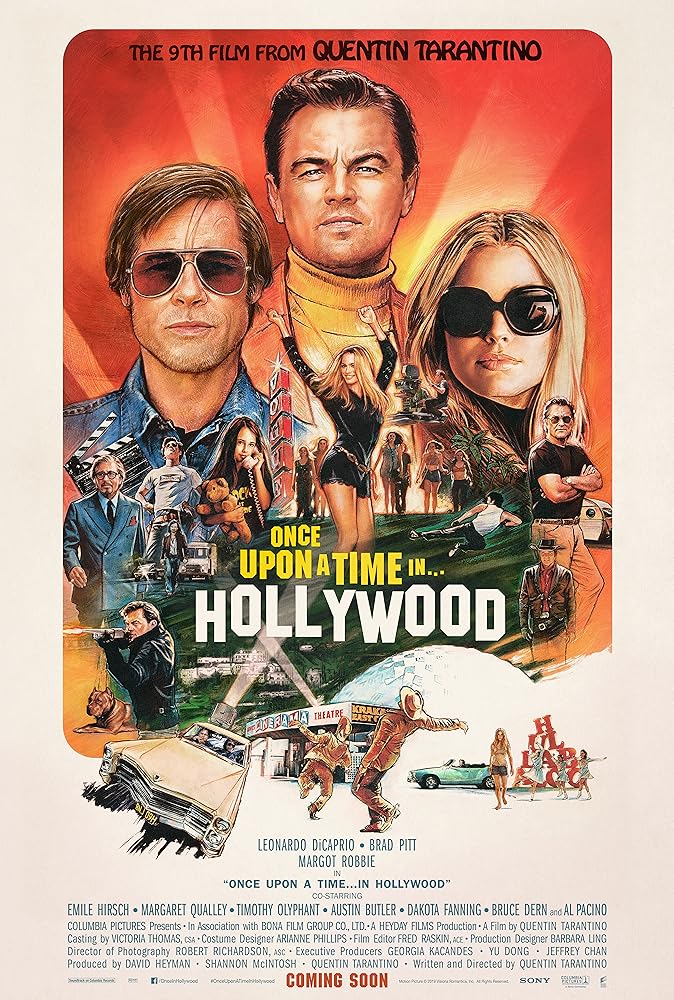
Tarantino’s plots are often a little difficult to relate succinctly, and this one is no exception. The film has three central characters: Rick Dalton (Leonardo DiCaprio), an actor who is afraid he has reached his prime and is headed downhill; Cliff Booth (Brad Pitt), Rick’s stunt double, who may or may not have murdered his wife; and the real-life actress Sharon Tate (Margot Robbie), Rick’s next-door neighbor on infamous Cielo Drive. The plot is observing these three for four days, two in February of 1969 and two in August of 1969, the latter time frame including the night Tate and her houseguests were savagely slaughtered. There are some gem moments to be found here, though. Rick has a nice exchange with a child actor (Julia Butters), who seems to take acting much more seriously than he does. The scene where Cliff gives a nubile young hitchhiker (a scene-stealing Margaret Qualley) a ride to the “Manson Family Commune” was an incredibly tense sequence, if only because we know better than Cliff does just how dangerous The Family can be. And although I thought Robbie was a little flat with her portrayal, there was a lovely scene where she gains free entrance to a theater showing one of her films, and delights in the audience reaction to her on-screen performance. I really wish they had done more with her. And I have to say, I think Margot Robbie is one of the most beautiful actresses out there today, but as attractive as she is, I just kept thinking that she’s still not quite as luminous as the real article.
All three actors are great. I usually don’t care for DiCaprio, but I liked the way he gave Rick some vulnerability. The stuttering, the self-loathing rants…it all worked. Pitt is solid (as he usually is), and Robbie is underused, but still shines at moments. QT packs the film with some of his regulars (Kurt Russell, Zoe Bell, Michael Madsen, etc.), but that, too, kind of took me out of the reality that he seemed to be trying to create. It felt too much like some kind of knowing wink to the audience.
The rest was a mixed bag. I thought there were some interesting comparisons made between the lives/domiciles of Rick and Cliff, but I thought Tarantino left that mostly unexplored, as he did with some other threads. For example, I mentioned that Cliff killed his wife. We don’t really know, though, whether it was accidental or intentional, and Tarantino doesn’t really address it other than a brief, ambiguous flashback. But depending on the answer to that question, we would see Cliff in two very different lights (which is likely why QT doesn’t actually inform us). There’s also a couple of nagging inconsistencies: Tarantino uses some voice over narration in the beginning of the film, then drops it, only to return to it briefly at about the two-hour mark. The tone is inconsistent as well. While much of it is funny, the fact that a central point of the film are violent murders that terrified the nation makes some of that humor fall a little flat. And finally, it seems to meander something awful. A tighter editing job could have removed a chunk of the film without losing too much.
In the end, I guess I can say that I think the film will be a serious Oscar contender; Hollywood loves nothing more than films about itself (The Artist, La La Land, etc.). My guess is that it will probably win for Best Picture, but I don’t think it should. I can think of at least a handful of films that I thought were better films overall. IMDb gives it a 7.8. That’s a little high for my liking, but I would give it a 7, with at least a point of that coming as a result of great performances by the leads, and the added caveat that I’m not that much of a Tarantino fan. (running time 2:41)
 Who Cares What You Think?