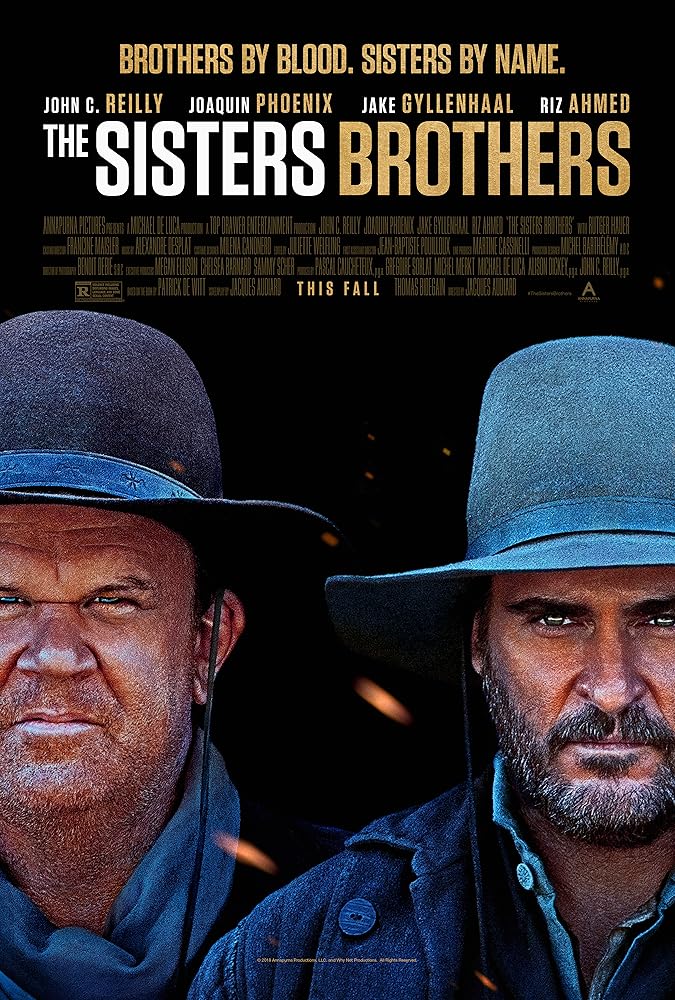
I knew nothing of this film before sitting down to watch it, but after a stark opening scene, with lighting-like flashes of a nighttime gunfight, followed by a horse, ablaze, galloping through the field like a living nightmare, I was hooked. Jacques Audiard’s film is a quirky tale that takes place in the Old West, USA. Charlie (Joaquin Phoenix) and Eli (John C. Reilly) are the Sisters Brothers. That is, two brothers with the last name of Sisters. They are assassins working at the behest of their “benefactor,” a man only known as “The Commodore.” They are both extremely good at their work but couldn’t be more different from one another at this point in their lives.
Charlie is a drunk, like their father, with a modicum of self-loathing. Eli, on the other hand, is at a point in his life where he is beginning to reconsider his life as an assassin and is ready to settle down—he wants to open a store. He’s found a woman he’s sweet on, going so far as to buy this newfangled item called a “toothbrush,” to make his breath sweet enough to kiss. “We’ve had a nice run,” he tells his brother. “We still have a little of our youth left.” Charlie is having none of it.
In addition to Eli and Charlie, we also meet John Morris (Jake Gyllenhaal), an investigator of sorts who is keeping tabs on the man the Sisters are supposed to kill—a chemist by the name of Hermann Kermit Warm, played by Riz Ahmed. (It’s great to see the two Nightcrawler vets working together again.) The only caveat is that before killing Warm, the Sisters are supposed to get his formula, which he claims will reveal the presence of gold in a stream. Considering that the film is set right smack dab in the middle of The Gold Rush, one can imagine how lucrative such a formula could be.
The film is one of convergence—we jump back and forth between the two pairs of men, knowing full well that at some point, the two paths will meet. And it’s quite unclear what will happen when they do. After all, Eli is uncertain he wants to kill anyone anymore, and Morris finds himself intrigued by Warm’s utopian vision for the future, which is what Warm plans to do with any gold he acquires.
The relationships are the interesting bit here. It’s not much of a traditional western, but it does at least acknowledge the underpinnings of the genre, if only to warp them a little, and the occasional gunfights, when they come, are fast and furious and unforgiving. Audiard mines the genre as adeptly as a surehanded gold-panner, waist-deep in the stream, throwing away anything he finds no value in. It’s not really a comedy, either. Sure, there are a few moments where you might chuckle uneasily, but there are far more moments of heartbreak and unease, and violence. In this world, morals don’t always seem to apply. There’s an exchange in Unforgiven between Eastwood’s Will Munny and Hackman’s Little Bill Dagget. Dagget, facing death, says, “I don’t deserve this.” Munny responds, “deserve’s got nothing to do with it.” I think the same thing applies here: there is no sense of Divine Justice, no comeuppance or reward corresponding with one’s deeds.
The acting is top-notch. Outstanding performances by all involved, but especially by John C. Reilly. It’s nice to see him in a serious role again. He works as the centerpiece here, lovably awkward when enlisting a prostitute to reenact the goodbye he shared with his true love, and exuberant upon seeing a flush toilet for the first time. The cinematography captures the landscape beautifully, without dwelling on it too much, and Alexandre Desplat’s often-lyrical score, although seemingly anachronistic (It sounds like something out of a 1970s cop show), works here amidst the genre-bending.
Don’t go into this expecting a traditional western; you’ll be disappointed. Don’t expect a western version of Stepbrothers, either. In fact, the fewer expectations, the better. The cowpokes over at IMDB rate this a 7.1. I liked it quite a bit, so I would boost my rating to an 8. It’s a definite contender for my best of 2018 list, which is late…again. (running time 2:01)
 Who Cares What You Think?