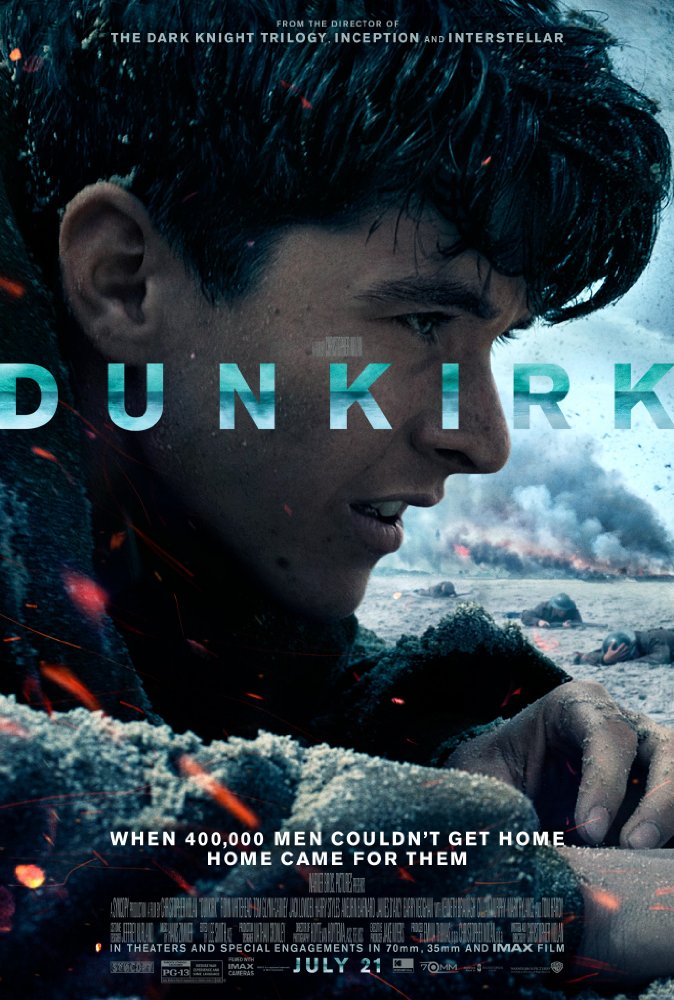
Michael Bay makes a film that places action over character, shoehorns in too much story for the running time, and fills it with moments clearly designed to tug our heartstrings, complete with a tear-jerker of a score, and the critics make him their whipping boy. Chris Nolan does the same thing, and it’s a masterpiece. Maybe I’m exaggerating, but there were moments in Nolan’s latest film, Dunkirk, that seemed to me just as carefully constructed to elicit the same kind of “guy cry” moments as ones in The Rock or Armageddon (and yeah, I cry when Bruce Willis blows himself up. What’s it to you?) That’s not to say I didn’t like the film, or those moments. They work as they’re supposed to. But in the end, much like the story of Dunkirk itself, the film seems like a failure dressed up to look like a success.
The story is told in three threads, corresponding to land, sea, and air. All three overlap, but as Nolan so often seems to do, he plays with the timing, cutting back and forth between them, so it’s unclear just when they’re occurring until they cross one another. In “The Mole,” Allied soldiers wait to board transports home, at the mercy of the surrounding Germans (who are fairly absent from the film, apart from damage they cause). In “The Sea,” Mr. Dawson (Mark Rylance) and his two teenage mates are crossing the Channel in his boat to help transport troops. (Those civilians who put their personal crafts in service to the cause became known as the “Little Ships.”) And last, but not least, Tom Hardy (his face once again hidden) plays a Spitfire pilot faced with what could be a life-or-death decision in “The Air.”
Hardy’s performance, despite his being more-or-less immobile and unrecognizable, was the most interesting, I thought, although the rest of the cast was good as well. There was a bit of melodrama here and there, although maybe it just seemed that way because we never really get a chance to know anything about these people. Cillian Murphy plays a “shivering soldier,” pulled from the sea, clearly suffering from shell shock. Why? We don’t know, apart from his muttering “U-boat.” Where is Hardy coming from? What squadron? Who, if anyone, is waiting for him at home? Again, we don’t know. Everything is rushed, as if Nolan wants us to feel the same impatience that the soldiers feel waiting for that next ship, that next bomb. Normally one would expect a film about a subject such as this to run between two and a half and three hours, but Dunkirk clocks in at under two.
The dialogue, what little there is of it, isn’t all that great, either, and often borders on schmaltzy, right down to a half-hearted reading of Churchill’s “we shall fight them in the…” speech at the end. (In fact, it is the visuals and score over the voice-over that lends that scene any emotional weight, when I think the speech should have been the centerpiece.) The cinematography was dead-on, though, and the muted color palette really brought a bleakness to the film, to match its tone. Thankfully, Nolan’s sense of the visual is right up there with someone like Ridley Scott’s, and he wisely used practical effects instead of CGI when possible.
It’s not informative enough to be a docudrama, and as a war epic, it’s not that…epic. It’s like an impressionist painting. If you stand back far enough, you see the essence of the thing. But for those of us who like to look up close, it seems incomplete. And I have to mention one last time the frustration with the lack of character development. Nolan has said this is a “survival” film, rather than a war one, but in any of the “survival” scenes (which seemed to be mostly about various ways to drown), I found it hard to identify who was who, and even harder to care about them as actual people. I thought back to the “disaster/survival” films I grew up on, and realized that I knew why Gene Hackman jumped out to turn off the steam valve at the end of The Poseidon Adventure. I wept for Shelly Winters when she couldn’t live up to the swimming skills of her youth, and later for her husband, played by Jack Albertson, because I knew he was going to have to go on without her, for their grandson. They were real people to me, and I had come to know and care what happens to them. I didn’t feel that nearly as much in Dunkirk.
That said, I still think the film is worth watching. It’s good. It’s just not the “masterpiece” that some critics are making it out to be. I dare say it’s not even among Nolan’s best. IMDB gives it a rather inflated 8.6. (Seems like somebody’s diggin’ the emperor’s clothes!) I’m not that enamored, so I’m knocking it down to a 6.5. If you’re a WWII buff (yes, dad—you should go see it!) or you like to be swept up in the emotional moment, you’ll enjoy it. Just don’t buy into the hype before you go. (running time 1:46)
 Who Cares What You Think?