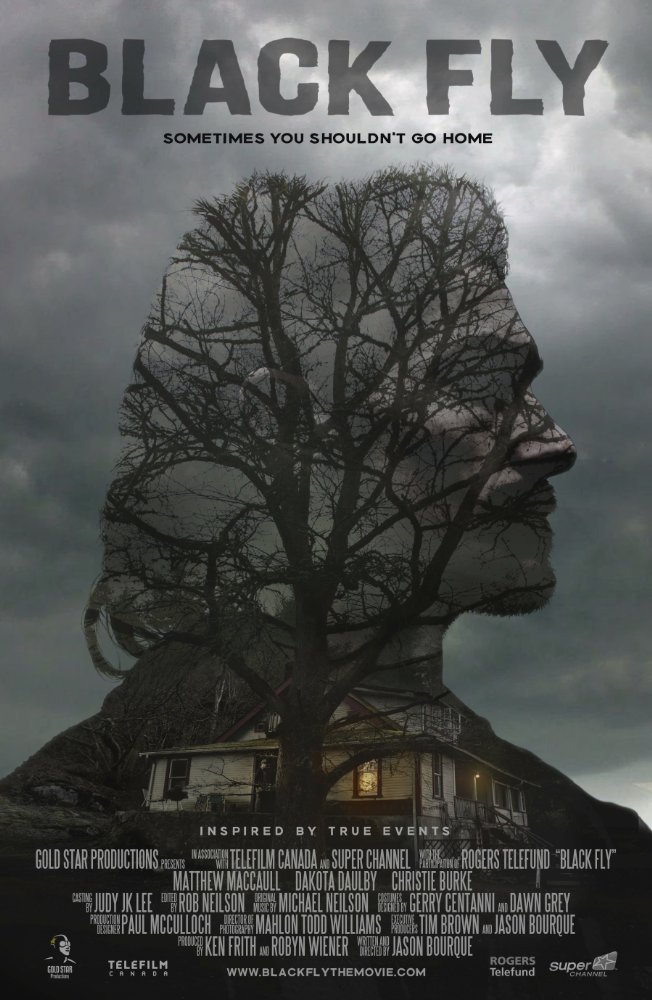
I love it when a movie catches me off guard. Black Fly was made on a shoestring budget (in Hollywood terms, anyway: less than a million), and shot in 14 days. I noticed some glowing reviews on IMDB, but the lack of overall votes and the fact that the same guy (Jason Borque) wrote and directed is more often than not a sign of a low-quality film made on the cheap, and promoted by having people associated with the film post over the top reviews for it. That way, they can make a few bucks on it before word of mouth catches up with them. As it turns out, that is not this film. Not by a long shot.
I hadn’t heard of Borque before this, but after a little research, I discovered he’s a bit of a journeyman, having honed his skills on a number of documentaries and made-for-TV movies over the last few years. Those projects clearly served him well, for he’s served us up a tense, gritty thriller that makes the most of what it’s got. Jake Henson runs away from the home he shares with his burned-out aunt and uncle, the latter of whom has apparently forced himself on Jake, and takes refuge with his brother Noel, the only family he has left after the deaths of his mother and father. There’s something off about Noel, though. He seems overly emotional, both in the passion he exhibits towards his girlfriend, Paula, and the violent rage that seems to live just below that easy-going surface. As the film stalks forward, an encounter with some bikers is just one of the triggers that begins a downward spiral of violence and lies, with poor Jake caught in the middle.
I believe that low-budget indies live or die on the strength of the acting. You can forgive a lot in a film, if you can believe in and care for the characters. And with maybe one or two exceptions, the performances here are rock solid, especially from the three leads—Dakota Daulby (Jake), Christie Burke (Paula), and an absolutely outstanding Matthew MacCaull as Noel. He reminded me a little of John Hawkes as Teardrop in Winter’s Bone (which you should see if you haven’t!) in terms of his seething unpredictability. He scares you even when he’s not trying to. Never for one second did I believe he was anything but the troubled, violent Noel.
There wasn’t anything terribly negative that stood out to me. I suppose if you twisted my arm, I would say that I would have liked just a bit more back story on some of the relationships, as well as why the bikers were there. It’s mentioned that they’re “trying to scare people off the island,” but unless I missed it, we’re never told why. The film is supposedly inspired by true events, so maybe it’s something Borque thought we should already know, but I didn’t. It didn’t make much of a difference, anyway. I only thought about it when it was mentioned in the story, and before I could dwell on it too much, I was caught up in another scene.
This is a really great film, especially when you look at what they did with so little. Great direction by Borque, who has a good eye for where to put the camera when setting up his shots; great editing that gives you the punch in the gut without being overly gory or salacious; great acting by the leads; and a story that—while perhaps not all that original—certainly grabs your attention and does its best to hold onto it throughout. It never feels cheap, nor cheaply made, and always feels completely honest in its relationship with the viewer. I think this might be another contender for my “best of the year” list. It’s listed as a 2014 film, but I believe it was previously only on the festival circuit, and is getting its major release this year. IMDB says 7.6 (although between the time I wrote this and the time I published it, it’s dropped to 6.1), and I would surely agree with that. If you liked films such as Winter’s Bone, Out of the Furnace, or this year’s Green Room, you should definitely give this one a shot. If nothing else, see it to see what talented filmmakers can do with very little money and time. If only there were more of that kind of talent out there. (running time 1:28)
 Who Cares What You Think?